


8th December 2004
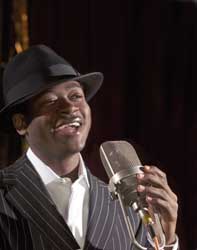
Chantz would strike strangers on the street as he played his trumpet and tell him he was young at heart and old of soul. He is an extraordinary mixture of extremes. Now 17 but has been playing trumpet since he was seven, he has an incredible confidence and maturity mixed with an amazing freshness.
He can’t categorize his music exactly, let’s just say it has a jazz base, takes on funk, soul, R&B, and he tap dances full-on Broadway style.
He was born in New Orleans, grew up mostly in Los Angeles, California with a stint at Jackson, Mississippi, and he and his mother have lived in London and Paris for the last two years.
Glinda Powell is a powerhouse of a mother. “She does everything,” says Chantz. “She is my manager, my PR, my hair stylist, she’s always going to buy me socks, and she’s an all in one package, very devoted.”
His mother, Glinda Powell, looks at her son constantly as if she’s seeing him grow and change before her eyes, and notices every nuance.
Chantz has been extraordinary to her since the moment he was conceived. She already had one son of 15, and was told that she would not be able to have more children. When she unexpectedly fell pregnant with Chantz, she was overjoyed. She took his name from the French ‘avoir de la chance’, which means to be lucky, blessed.
When Chantz was about six years old, Glinda took him to see the Spike Lee movie, Mo Better Blues, which was about the dramatic life of a trumpet player, and from that moment on, he started begging for a horn.
He says, “I can’t remember asking for the horn or getting it, it’s always been there, part of me. I don’t know which is my favourite thing - singing, tap dancing or trumpet playing - that’s why I do all three. But I know when I feel low I grab my horn and start to play.”
Soon after the trumpet came a CD of Louis Armstrong Greatest Hits.
Chantz says, “I am glad Louis Armstrong was the first trumpet player I listened to. This got me hooked. I loved it. When I heard it I thought this is what I want.”
He went to the Louis Armstrong jazz camp in New Orleans at nine. When he returned to LA his mother was “in between pay cheques and he said mama I can make up some money. He had tried busking once before but only got three dollars.”
It started with a trip to Venice Beach where he saw a guy playing the trumpet very badly but they were still tipping him. Chantz knew that he could do much better, so with just enough money to cover the gas, they headed off to Venice Beach and came back with a profit of $45.
And from that point on Chantz busked regularly and began gathering a massive fan base from the streets. And when he entertained, the money rolled in, and this went to fund his studies with some of the best talents around. He had private trumpet lessons (with Nicholas Payton, Scotty Barnhart, Chris Tedesco), vocal and piano coaching (with Leonard Reed, David Rishton) and studied at some of the best performing arts academies around (Colburn Performing Arts, Amazing Grace Conservatory, Marlene Dove Theatre Company).
“Chantz’s music can change the world, that’s what I see, I see people inspired by him, people saying I don’t like jazz but I love this. People having a lousy day until they saw Chantz and saying, you’ve changed that”, says Glinda.
At the age of nine in Jackson, Mississippi he was a support act for ‘Showtime At The Apollo’, the legendary US TV show and career launch pad for many musicians, and played for an audience of 9,000.
“I know they hadn’t come just for me, but they were all whooping and hollering. If you play for 9,000 there’s no looking back, it means that I’m never nervous for gigs. Playing on the street also does that. People can tell you the worst things and you don’t let it get to you. They can walk by and not even look at you, so that makes you play louder and play your heart out. So when people actually come to see you there’s this whole different kind of energy.”
Another kind of energy was soon to become part of Chantz’s repertoire, a kind of explosion, sparked off by the incredible fast-footed tap dancing he would master. This came about when he was visiting New Orleans and saw tap dancers on the Streets.
“It was in the French Quarter, Bourbon Street, where all the music, madness and Mardi Gras happens. They had bottle tops on their tennis shoes, so I immediately put them on mine.”
Professional tap lessons followed with a woman called Lainie Manning who had choreographed top Broadway shows. Chantz says, “At first she made me realise that actually I was no good. But it soon all came together, I’m not sure how. Trumpet playing and singing came first because I knew the notation for the songs, then everything else just melted.”

By the time he was 14 they were back in LA, Glinda had a good job in the travel business. But after 9/11 the travel business struggled and she got laid off.
“I thought what better time for us to go to Europe. We could go to Paris and study at a conservatory there and busk our way across Europe. We stopped off in New York and almost were not going to leave because we were doing so well. He was getting all these fabulous gigs, one with the Duke Ellington Orchestra.”
Chantz says, “On a Saturday night, if we hadn’t made $700 to $1,000 we were having a very bad night.”
Glinda felt in her heart though that Europe was the place for them. She had hooked up with an international manager who had connections all over Europe and Chantz was booked into festivals. He studied at the Nadia Boulanger Conservatory in Paris (where Quincy Jones and other great composer arrangers have studied) and was all set to remain there, but when September new school term started (in 2002) he felt his French wasn’t good enough for high school and that’s what made them come to London.
First off they were playing in Chinatown and immediately were booked for the Cafe de Paris. From there they were booked for private parties and from one of those came the deal with Universal’s Decca label. He currently studies at Trinity Music College.
There is no doubt that he communicates through his music with a passion. And it is his music that brings him in and brings him together.
The album Stories Of Me is about, “My journey, my mum and I together.” Glinda says, “He’s learnt to be fearless about life, to get through hardship. He has learnt to be a master surfer, how to ride the high waves and the low.”
Chantz says, “Let The Good Times Roll is about the many times we had to come together to party no matter what.”
The track The Story Of Me is one that he wrote. “It’s about how you can’t go through life untouched by love. Everyone is on a mission, whether it’s to invent something or love someone that you didn’t get a chance to in another life. I believe that in every life you have a goal and if you don’t reach it you come back until you do,” he says with one of those mysterious old soul smiles.
“When I first got to Paris I felt as if I’d lived there before. I knew where things were without a map and had an eerie feeling in my stomach.”
Like Chantz, there are many moods and styles on Stories of Me, unexpected things coming together, reflection, nostalgia and R&B inflections, full on soul tracks. “I worry about being categorized, it’s jazz with a modern take but it’s not modern jazz. It’s R&B, pop, soul, funk tap dancing.
“Work Song expresses how I felt for the past four and a half years about the work. They All Laugh is my song for those people who said I was not going to make it, and those same people pretending to be my friend. But it’s about who has the last laugh now, I do.
“Don’t Mean A Thing is the third song I ever learned, so it’s part of me, I’ve been playing it since I was eight. In These Shoes is for the ladies, that’s my sex symbol song. I’ve been going to the gym and working out a lot, I like the ladies too much.
“Do Your Thing speaks for itself really, it’s what everybody should do. Sometimes it’s hard because people will be negative and egos will get in the way, but that’s all you can ever do, your own thing, and that really is the story of me.”


David Jensen Photography:
https://www.davidjensen.co.uk/